Monday, November 9, 2009

The Gustavian opens in Manila

The Gustavian is here in Manila, and has found its home rightfully in Eastwood Mall.


The Gustavian is an established restaurant in Cebu. When I first tried Gustavian years back, I immediately fell in love with the place, even though the food was not 5-star for me. So take note, a dining experience sometimes is not just about the food. The ambience can really make everything feel and taste better.


Even before Chelsea, the Gustavian was already making waves in the Queen City of the South. The branch here in Manila is small though, and can only accommodate 50 guests, which I think is good. At least, it won't get rowdy.


I like their sandwiches, since they are simple and relatively inexpensive. I ordered a Forest Ham panini (P160) which was lacking in flavor. The panini bread was great though.


My sister ordered a Spaghetti Pesto (P180) which was better than I expected. We were here for a snack, so we weren't able to order more.


I'm happy that the Gustavian is now here in Manila, and I hope it gains strength to fight the growing competition in Eastwood Mall. The last thing I wanna see is the deli restaurant closing, and heading back home to Cebu.

The Gustavian is located at the ground floor of Eastwood Mall, beside Old Vine.

Resorts World Manila

I recently went a spontaneous trip to Resorts World in Newport City in front of NAIA 3. We were supposed to have dinner at the Fort, but I drove myself up McKinley, and eventually found myself heading straight to NAIA3 like I was on auto-pilot. I was missing traveling I guess.


I was surprised at the casino hotel. I immediately felt I wasn't in Manila, but more of Macau. Resorts World hasn't been completed yet, but I envision the hotel to make waves once it fully opens. The decor is luxurious, red and gold furnishings with modern elements.


I went there to meet the barkada, but I arrived early, so I booked us seats in a restaurant inside the casino area. The casino area is the only facility that is open so far. Of course, I couldn't take a picture of the casino, but it looks like any modern Macau or Vegas casino. It's that good, way better than the PAGCOR one in Paranaque. Though I don't gamble, I took a shot in doing slots. I got a membership card which I used in the slots.


So, if you have time, check out Resorts World. There's a lot of wholesome adult entertainment in store. I was surprised that there were actually a lot of people already, making the place full on a Friday night. I can't wait for the rest of the hotels like Marriot, Maxims and Remingtons to open here. This endeavor will surely boost tourism in Manila.

In and Around Bongao

Bongao feels more like an island town than Jolo. You can still see a lot of trees, and the topography is hilly. Thus, you don't see a lot of rice fields. Downtown, the action is pleasant and vibrant. Lots of umbrellas in different colors lined up the streets around the public market.


We took a short drive around town, starting with the market. We moved to the Chinese pier as they call it, where a lot of Chinese traders have their warehouses and boats filled with various merchandise from Malaysia and Indonesia.


In fact, there was a boat sailing to Sandakan in Malaysia. The trip supposedly takes 8 hours, which I think is not bad. Tawi-Tawi is just beside Sabah, so it's practically part of it already.


I really didn't feel threatened here, and they don't seem to look like Muslims. It's just like any other Filipino town. I was happy to see more smiles here, than in Jolo. The people don't seem to complain, but you can see that poverty still abounds.


We moved uphill to one of the highest points in town, the provincial capitol. They really make their capitol buildings extravagant here.


The view from above is breathtaking. You could see a panoramic view of Bongao, and even some of the other islands of Tawi-Tawi. Sinumul can be seen from this point. I was pointing to beaches left and right, and wondered if there were ways to get there. Again, I got the look, "it's not safe going around".


It was almost sunset so we took great pictures from the top. The air was cooler too. We saw a lot of families hanging out here, just enjoying the breeze while watching the sun set.


My trip to Tawi-Tawi was unexpected, and thus, I wasn't really able to prepare. Hopefully next year, I would be traveling to Sitangkai, the last town of the country to the South. I hear the beaches are fabulous there. As I jetted back to Zamboanga, I couldn't get my eyes off the islets and sand bars that began to show up again, waving goodbye to me and wishing me time to come back.

Saturday, October 17, 2009

The Houses on Stilts: Tawi-Tawi

We decided to head back to Bongao, and pass some more spots that we could along the way. We actually took a path that encircled Bud Bongao. There were a lot of green on one side, and to the other, blue all the way.


Of course, Tawi-Tawi won't look the same without the houses on stilts built by the Tausugs and the Badjaos. Tawi-Tawi is also known to be an area for migrants from Malaysia and Indonesia, though I heard most of them are not happy that they are here. Nevertheless, they put up residence on bamboo stilts on the shallow white sand beaches along the coast.


Some of the areas we passed by were entire communities that looked like a village on stilts. Some houses were abandoned though. Some even had the flags of their tribes on poles.


The sun was setting on the other side of Bud Bongao, though some of the rays pierced through to give us a dramatic setting. We found a sand bar that stretched to sea for around 200 meters. Yes, that was long, and it gave us a very nice vantage point to take pictures of the houses on stilts with a backdrop of Bud Bongao. How Tawi-Tawi can you get?


I couldn't resist taking a picture of myself. We all did. The view was really stunning even if you looked up. The tide was coming up, so the sand bar was slowly devoured by the blue sea until I made it back to shore.


There were really a lot of sand patches and bars in Tawi-Tawi, and I wouldn't be surprised. I really think the Sulu and Tawi-Tawi islands has so much potential for tourism, but the unruly situation has just destroyed that. I really HOPE that the rebels feel that this war will go nowhere, and that the government will never have the capability to solve this. It's really not a war I think. It's more of lack of development, resulting to poverty, that leads to all this mess. And the locals are the ones suffering.


Well, I couldn't help but express my frustration over this entire area. I was looking back at Bud Bongao and the beaches, and thought if I showed the world that this place is safe and beautiful, would people start going here?


Well, I wasn't able to answer that question, so I boarded our multicab and headed back to town for our last stop: the provincial capital that I heard had a nice 360 view of Bongao.

White Sands in Tawi-Tawi

Landing in Tawi-Tawi was a dream. I never thought that this would be the year that I would be going to the Southern most province of the country. Hence, I didn't make any plans. I only have one night here, so I wanted to make the most out of the trip. Of course, that would mean hitting the beach.


After the frustrating no-beach experience in Sulu, I made sure I would be stopping by to get some sand on my feet. After all, I knew Tawi-Tawi was safe, and the people were nodding their heads when I kept asking if we could go to the beach. So, after work, we headed straight to the store, bought some beer and chips, and made out way South of town. Actually, there would be no problem looking for a beach here, since they're everywhere on the coast. We passed by a coastal road that had a lot of white coral beaches, but most of them had houses on stilts. So we moved further away from town to find a secluded spot.


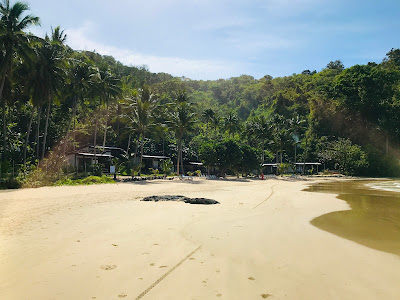
And this is where we ended up in. Coconut trees were swaying to the gentle breeze. Tattered nipa shades were eager to hear visitors coming to sit under them. White coral sand stretched until the very end of the coastal line, with giant carved rocks waving a sweet hello to us. I never felt more at ease this year.


The unknown beach also had a stunning backdrop of Bud Bongao, who peeked intently through the coconuts trees as we jugged down beers and played with our camera shutters. The place looked like a mild storm passed by recently, but to me, it made the ambience more charming, more secluded, more of paradise.


I heard there are better white sand beaches in the southern islands of Tawi-Tawi, like Sibutul and Sitangkai. I was also told that there may be a possibility of me going there next year, if work pushes through.


Well, I really didn't care about fine white sand. I actually had seen more than enough here. For some reason, I felt at peace here, as I watched the waves from far away. Tawi-Tawi makes you feel so different, maybe because it makes you feel far away from home, even if you're still in the country.

Friday, October 9, 2009

Landing on Bongao, Tawi-Tawi

From Jolo, we went back to Zamboanga to catch another Sea Air flight to our next exotic destination, southern most province of the country, Tawi-Tawi. We already felt we had a private plane to ourselves, since we always rode the same plane.


The view from above was not as clear, and the flight was deafening and longer. It took us 1 and a half hours from Zamboanga to Bongao, the capital of Tawi-Tawi. As soon as I saw Bud Bongao, the highest peak in these islands, I was having headaches from the sudden descent. Our pilot had to go around again and take another chance in landing the small aircraft.


So we landed safely, and awaited for our gracious hosts. I immediately sensed Tawi-Tawi was going to be different from Sulu. We had no police escorts, and the presence of the military dwindled. We rode a red multicab and drove off to the center of Bongao town, passing by the coastline and going around Bud Bongao.


We arrived in our hotel, Rachel's Place, which is one of the 4 accommodations in the island. It is located near the town center, and looks like the biggest and most preferred place. Get the rooms (P800 to P1200) in the new building though, as they are cleaner.


From here, we had lunch at the venue of our shoot, Lutong Bahay sa Bongao. It seems that there is a lack of food places in Tawi-Tawi. There's even no Jollibee. But you can get a lot of fresh seafood from the market, and they can cook them for you as well. Lutong Bahay sa Bonao is cozy place to eat, but don't expect a different menu. It's your typical carinderia.


We rode our multicab to get a tour of the town. I saw a bustling market place which was colorful. Stalls selling clothes, DVDs and a lot of stuff from Malaysia lined the narrow alleyways. There was a mall being built, but people don't know when construction would finish.


Bongao had its charm that I expected. I felt much safer, but people still warned us to keep a vigilant eye open. Tawi-Tawi is considered free from terrorism, but they say some of the Abu Sayyaf bandits spend their vacation here. Like everyone else, the bandits just want a place more peaceful and pleasant.

More on Tawi-Tawi in my next posts...

The Unforgettable Trip to Jolo, Sulu

When I heard that I was going to Sulu for a shoot, I almost fell off my chair in excitement. Despite all the warnings and numerous prevention measures by my friends, I was able to hop on a plane to Zamboanga City, for my Sea Air flight enroute to Jolo, the capital of Sulu.


I expected Sulu to be beautiful, after hearing all the nice places there from people who have been there. We were descending already when I saw these island patches and long sandbars, with houses on stilts. I have never seen anything like that. Well, if there were inhabitants there, then there must be a way of going there.


We landed at the airport, which was bombed a week before we arrived. The runway was being constructed, so we had to board a jeep to take us to the terminal. I must say, the military presence and feel of the place scared me a bit. And after hearing the news about the recent bombing, I really felt uneasy. But, excitement still won me over, and I hastily jumped into our jeepney service that was followed by a military police escort.


We arrived at our "hotel", the only safe place to stay at in Jolo, the Peacekeepers Inn, located inside the police compound. Well, I can't say much about the inn, only that it felt like a prison ward. Gates were high and barb wires surrounded the perimeter. I was told that this was where the media people stay, so they assured me we were going to be safe here. But then again, the police told me to tell him if I would go out of the inn, even just to cross the street to buy from the sari-sari store in front.


The weird and uneasy feeling didn't go away though. When we surveyed the town, I felt more scared. Jolo was unlike what I pictured it to be. It was dirty, arid, humid, dusty, noisy. It was so underdeveloped and mismanaged, that I felt I was in Africa. There was a huge mosque at the center of town which was quite a prominent building with its massive white walls.


After checking in, we went to do some work (shoot an interview that we conducted). Afterwards, we had lunch at a rundown restaurant. From 3 police escorts, we suddenly had 12, and I was told to ride the police car. I felt something was wrong, but they weren't talking. It was Ramadan, so the police, who were all Muslims, remained in their vehicles when we had lunch. I was happy to be served some dishes that I never had in my life, like the Black Soup as the locals call it. The Black Soup is actually like tinola (ginger chicken soup), only spicy and mixed with burnt coconut to give it a distinct flavor. I liked it though, along with a special kind of beef curry that was also served.


Anyway, after lunch, we were treated to a tour of Jolo. I saw more of the poverty that probably is the primary cause of the unrest here. The police told me that the people were so poor that they'd rather join the rebels (Abu Sayyaf) because they could make money from kidnapping, etc. It's a vicious cycle, and I think the situation will last longer unless the government really DOES something. I felt nothing was really being done.


We went to the capitol grounds, where the Sulu provincial capitol building was located. The building was grand, and looked like the Taj Mahal in a way. It was a nice area, and empty. Guards were at the gate, and regulated the entrance of people. There was a swimming pool and a lot of gardens. I just wished that this was Jolo all throughout. But it was just the capitol grounds.


I was encouraging everyone, even the police to take me to Quezon Beach, but they told me it was unsafe there. I was still persistent, so they took me to a beach nearby. As I approached the coastline, and finally breathed some fresher air, I was hoping we could stay for a while on the beach. However, the police car in front of the us took a sudden u-turn and our jeep followed. I was shouting to the driver to go straight, but we hurried away. I was then told that some bandits were closing in on us at the end of the road. Well, too much for an afternoon on the beach, which was so inviting with its bright hues of blue and white sand.


We went straight back to the inn for a break. We had some beer at the backyard, and even took a nap, before we were fetched at 6PM for dinner. All 12 of our police escorts, including the very friendly and accommodating police chief waited for 7PM, before having their fill. We had a seafood feast of crabs, grilled fish, fresh seaweed, squid and a whole lot more. There were several native delicacies served for dessert. Our hosts gave us some fruits to take home. We were supposed to go back to the capitol grounds to see the lights, but power was cut in the entire town, and it was again unsafe (the police spotted two motorcycles following us). So, we retired early to bed, well, just after having 2 rounds of beer.


My trip to Jolo in Sulu was indeed an unforgettable experience. I had so many mixed emotions about the place. I was so frustrated that I wasn't able to see the real beauty of the Sulu. I had to blame the bandits who just made the place virtually cut off from the rest of the world. Though most of the people on the street looked like terrorists, I found some of the people, especially the police and our hosts, very friendly. They were happy to see us, and more excited that they had visitors.

In the end, I found out from the police chief that there was an attempt to kidnap us. We would be more in danger if we stayed another day. Good thing we only spent a night. The entire gang took us to the airport and even waited for us for 2 hours to board the plane. They told us they wanted to make sure we were safe INSIDE the plane. It was an uneasy feeling, but comforting as well, that, in this restive place, there are who still care for others.